According to an article written for MasterClass, the weaving of Damask in particular was developed during the early Middle Ages (MasterClass, 2021). Something rather obvious that I had never thought of until looking into this weave is that its name originates from the city of Damascus, Syria (Charkes, 2022). That said, the physical location its name is associated with only allowed the weave to gain popularity on the Silk Road and eventually make its way to Europe, where it would then be reiterated by various countries. Its historical usage consisted largely of interior textiles, specifically for those who held status and money, but also clothing, and interestingly – religious garments (referencing Catholicism in particular, as this particular source is Italian) (2021). (As a VERY interesting aside, this source is actually a historic Italian Weaving Mill! I pulled my information from a variety of sources, but I certainly recommend checking out the last source listed below – I was ecstatic to have found it!)
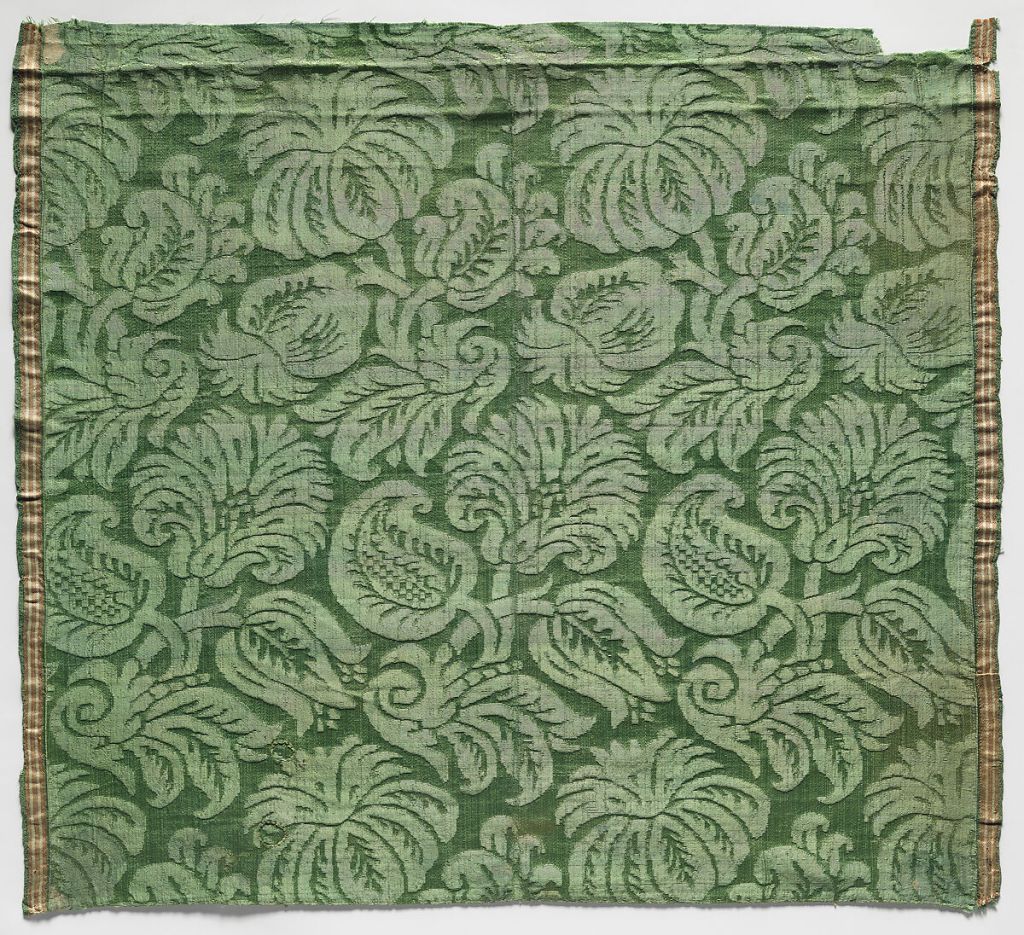
In searching for a close-up of this fabric, I found it most impactful to share an exhibit at The Metropolitan Museum of Art, which only reinforces its historical significance!
It is best known for its natural inclusions like florals, leaves, and sometimes even fruit, arranged in a symmetrical and repeating pattern. The implementation of these themes and imagery, paired with the intricacy and process involved with the creation of the fabric itself, prior to automation, was a long-standing display associated with elegance and luxury. An interesting note in an Elle Decoration article specifically mentions the fixation on this fabric by Henry VIII (St Clair, 2024), which stood out to me.

This portrait of Henry VIII, sourced from the National Portrait Gallery, includes a clear portrayal of a Damask backdrop, furthering the points made by St Clair and also furthering my own point of this fabric often being associated with luxury, elegance, and, in this case, royalty.
An interesting point made by the aforementioned MasterClass article is that Damask and Brocade can sometimes be confused due to their similarity. The two weaves can be distinguished by a few different factors, as covered by the article: the texture that the fabrics present (while Brocade is typically raised, Damask maintains a more flattened appearance), color (Brocade is often multicolored, while Damask historically maintains a single color – also mentioned by Charkes’s article), and origin of shine (the Satin weave of Damask establishes an inherent shine, while Brocade implements metallic thread to establish a shine) (MasterClass, 2021).
In the present day, Damask is commonly seen in interior decorating, as can be noted by a simple Google search – there are plentiful articles surrounding its usage in upholstery and wallpaper specifically. This continued usage, and the common presentation within the home, provides insight into the idea that it hasn’t lost its conceptual luster and still serves as an image of elegance.
References
Charkes, E. (2022, October 23). The history of Damask Textiles: 2,000 years of elegance. The Memo – A Blog by Schumacher. https://schumacher.com/blog/history-of-damask/
The Metropolitan Museum of Art. (n.d.). Green Silk Damask – Italian, Venice or Genoa. The Metropolitan Museum of Art. https://www.metmuseum.org/art/collection/search/216471
MasterClass. (2021, August 12). Everything to know about Damask fabric: History, characteristics, uses, and care for damask – 2026. https://www.masterclass.com/articles/everything-to-know-about-damask-fabric-history-characteristics-uses-and-care-for-damask
National Portrait Gallery. (n.d.). NPG 4690; King Henry VIII. National Portrait Gallery. https://www.npg.org.uk/collections/search/portrait/mw03081/King-Henry-VIII
St Clair, K. (2024, January 29). A brief history of a fabric: damask. Elle Decoration. https://www.elledecoration.co.uk/decorating/a46452694/history-of-damask/
Tessitura Luigi Bevilaqua. (2021, June 18). The Irresistible Lightness of Damask. Luigi Bevilaqua. https://www.luigi-bevilacqua.com/en/lightness-damask/


Leave a Reply